

Social Media Publishing
3 min read
Choose a project and a reason to make it
A Canadian sewing pattern creator sells a reversible market tote pattern. The creator wants to know what brings the right visitors to the pattern page before the spring market season: seeing the finished bag or knowing the project suits the fabric they already have. The pattern, timing and numbers in this example are fictional. Use the regional data for the market you actually serve.
Choose the relevant region in Pinterest Trends and compare a few phrases that match the product, such as “market tote sewing pattern” and “reversible tote bag.” Look for when interest starts to rise and check that the corresponding Pins match what you plan to offer. The plotted scale is relative, so a score of 100 should not be read as 100 searches. See Pinterest’s Trends guide.
Copy this four-Pin test
Assume the historical trend begins rising four weeks before an early May market season. Start the following example in that window. Use the same working pattern page and similar layout across the four Pins. Use distinct shots so each version is recognizable. Give each row a separate label in your log.
| Slot | Creative and text | Question for the reader |
|---|---|---|
| Week 1, Tuesday · A1 | Photo of the tote packed for a market. “Sew a reversible market tote.” | Can I picture using the finished bag? |
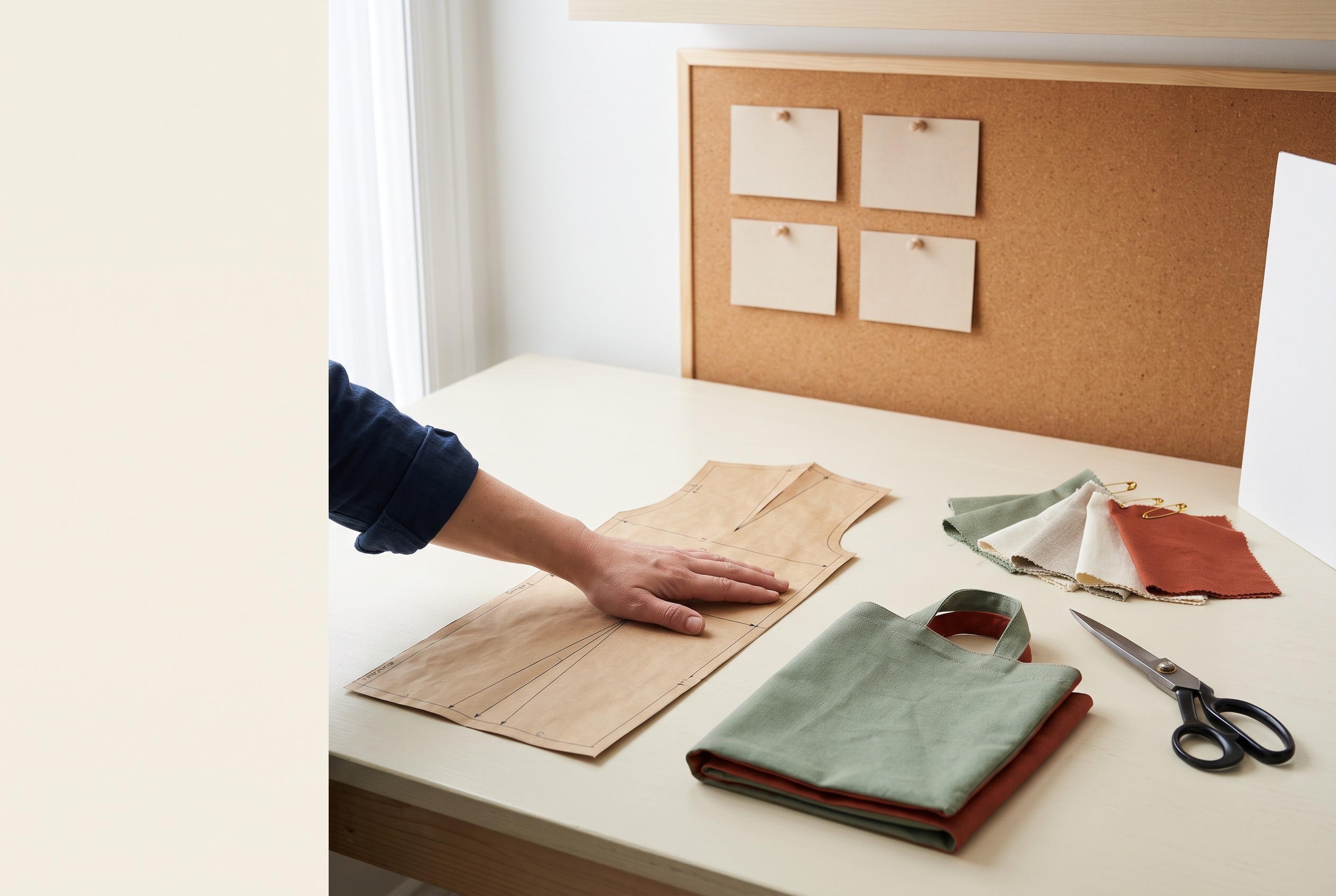
| Week 1, Friday · B1 | Flat lay of the tote and the two fabrics. “Two cotton prints, one market tote.” | Can I make this with fabric on hand? |
| Week 2, Tuesday · B2 | Close-up of pressed seams and fabric pieces. “A tote for two coordinating fabrics.” | Do the materials sound manageable? |
| Week 2, Friday · A2 | Photo of the same tote turned to show its other side. “One tote pattern, two looks.” | Is a reversible finish something I want? |
Measure each Pin at the same age
Record impressions, saves and outbound clicks after the same number of days for every Pin, for example 14 days. If your goal is pattern-page visits, prioritize outbound clicks and their rate. For instance, 21 outbound clicks on 1,400 impressions is 1.5%, while 9 on 1,050 is about 0.9%. Open the destination on mobile and check that shoppers see the pictured pattern and fabric requirements. Metric definitions are in Pinterest Analytics help.
Look for a direction that repeats across both Pins for an angle, then build the next pair around that idea. This is an organic publishing test with unequal distribution, so a difference is a reason to run another pair rather than proof the headline caused it. If the result splits, retain both ideas and make the next pair more comparable.
When the keyword or the stats are too thin
If a narrow phrase has no usable trend, check a broader adjacent phrase and label the timing an assumption. Keep the Pin honest about what it offers. Pinterest also says its Pin stats can aggregate Pins sharing an image and, when applicable, a URL. If you reused identical art or cannot separate results, rebuild the creative as distinct images and review the counting rules before comparing. See Pinterest’s Pin stats guide.