

Social Media Publishing
2 min read

Publish the original on your site first. Give partner sites a distinct summary, or agree on how a complete republished copy will be indexed. A canonical points search engines toward the URL you prefer. They can still choose a different version.
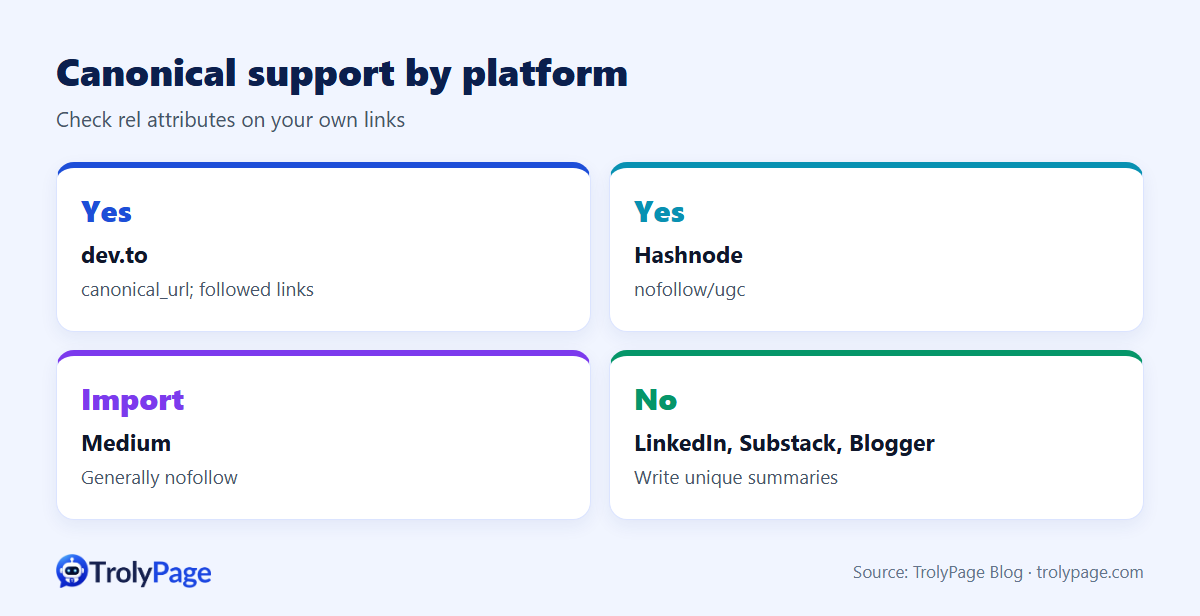
Canonical support by platform
| Platform | Where to start |
|---|---|
| dev.to | Yes, canonical_url in post settings |
| Hashnode | Yes, original URL setting |
| Medium | Yes, via "Import story" |
| LinkedIn Articles | No canonical |
| Substack | No canonical |
| Blogger | No easy canonical |
Platforms change policies; check the rel attribute of your own link after publishing (view source).
Workflow
- Publish the original and check it with Search Console. Indexing time varies.
- Set the canonical to the original URL where supported and inspect the live copy. If the partner can keep a syndicated copy out of search, agree on that index setting before publishing.
- On other platforms, publish a 300–500 word summary with a link to the full article.
- Adapt the intro and title to each platform's audience.
- Track referral traffic from each platform.
What not to do
- Copy the full article to many sites without canonicals.
- Stuff links or exact-match anchor text.
- Republish before your original is indexed.
Automating the routine
Some publishing tools can post to blogging platforms as well as social networks. TrolyPage's publishing covers multiple connected channels; check the features page for the current list before planning automation.
FAQ
Does cross-posting cause duplicate content penalties?
Google can select one version for search. A canonical is a signal. If you want a syndicated copy excluded, ask the partner to apply a noindex directive to that copy.
Which platform brings the most readers?
It depends on your topic: dev.to for developers, LinkedIn for B2B, Medium for general audiences.
References
Written by the TrolyPage team. Updated November 2026.