
Customer Support Operations
2 min read
Follow-up messages that don't feel pushy share four traits:
- They add something new: info, a photo, a stock update.
- They're short.
- They ask one easy question.
- They stop as soon as the customer replies, buys or says no.
Timing also has to respect each channel's rules. On Messenger and Instagram, that means within 24 hours of the customer's last message.
Timing rules
| Situation | When | Channel note |
|---|---|---|
| Asked price, went quiet | 2–12 hours later | Within 24h on Messenger and Instagram |
| Abandoned order details | 1–3 hours later | Same |
| Back in stock | When it arrives, if they asked | Check the window; otherwise wait for them to message |
| Post-delivery check-in | 2–3 days after delivery | Email or a channel where you're allowed |
| Replenishment | Based on usage cycle | Opt-in channels only |
Templates
Interested but quiet
- "Good news: the [size] you asked about is still available. Want me to hold one?"
- "Here are two real photos in daylight. Which color do you prefer?"
- "If budget is a concern, [alternative] is $[price] with a similar style. Want to see it?"
Incomplete order
- "We just need your address to finish your order. Shall I keep the item reserved until [time]?"
After delivery
- "Your order should have arrived. How does it fit? Exchanges are easy if needed."
- "Glad you like it! A quick review would really help us: [link]."
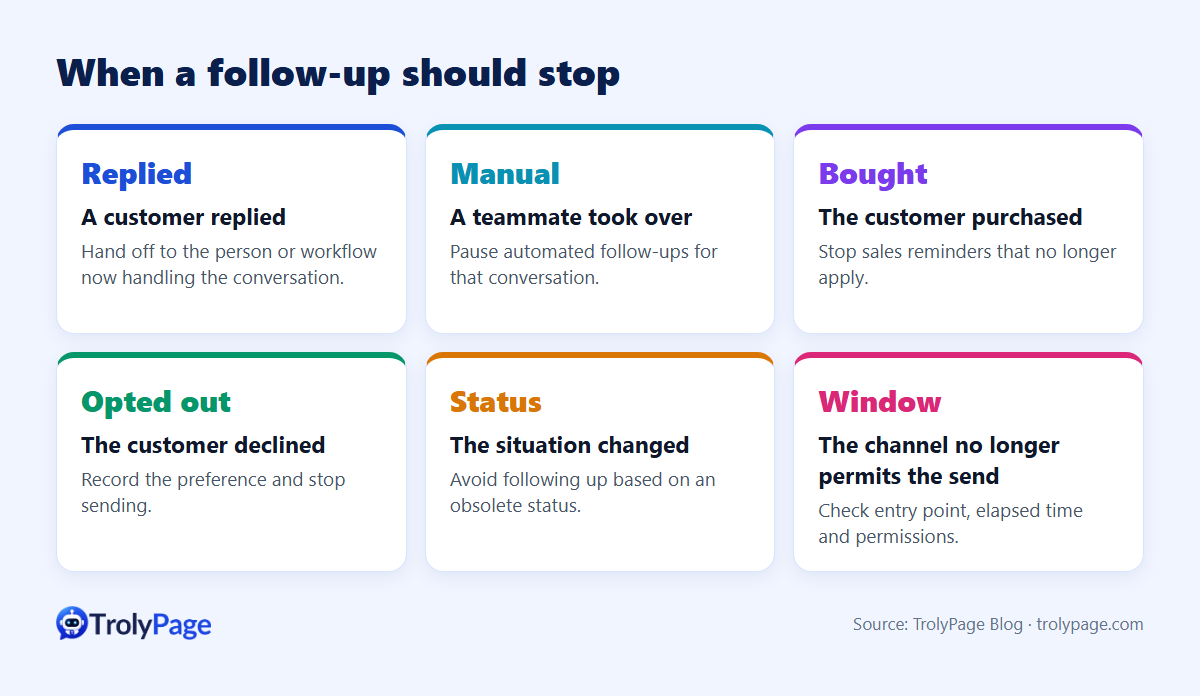
Stop conditions (non-negotiable)
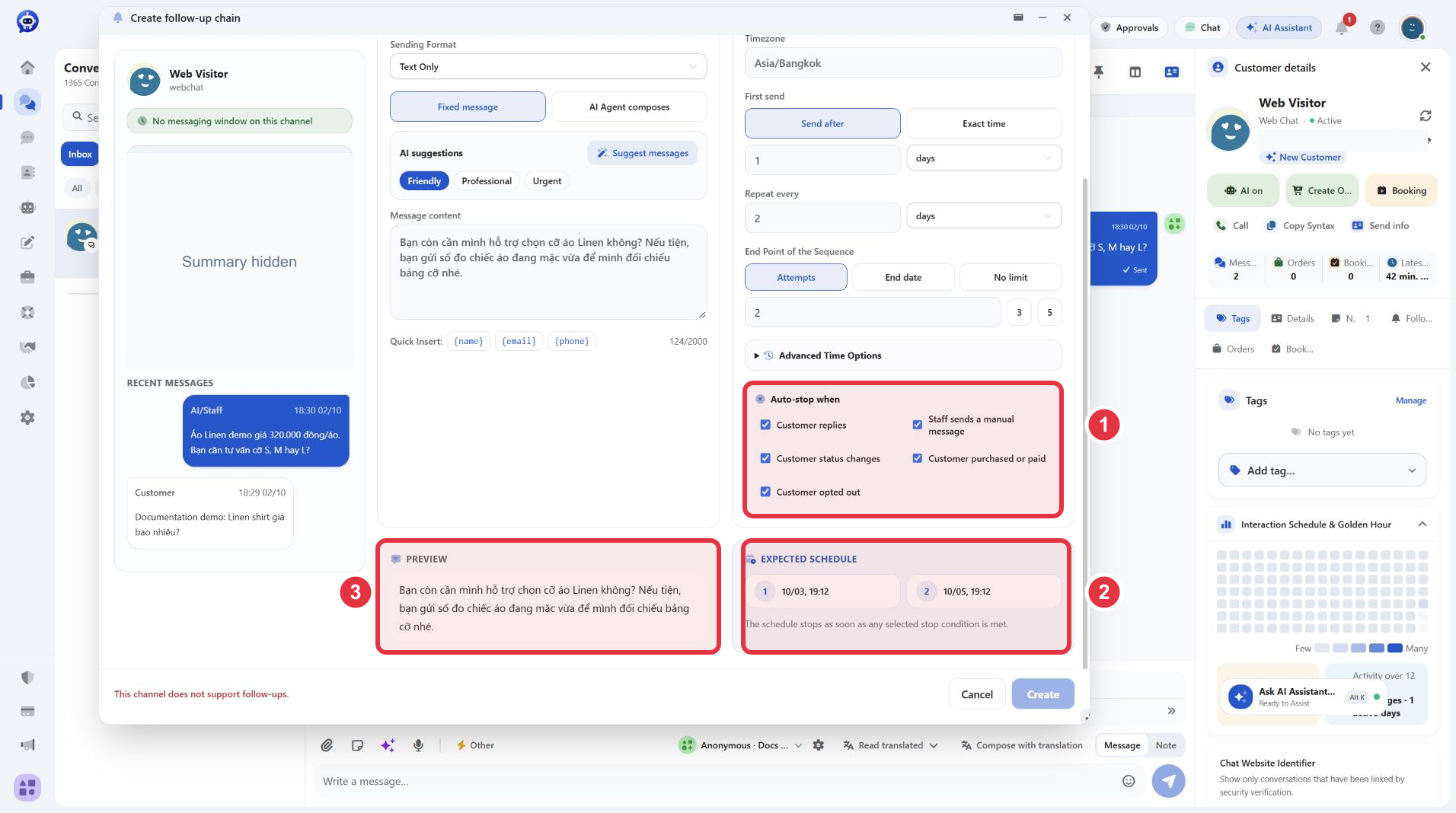
- The customer replied.
- A teammate sent a manual message.
- The customer purchased or paid.
- The customer opted out or said no.
- The customer's status changed.
TrolyPage's Follow-up includes these auto-stop conditions, shows the expected schedule before you create the sequence, and locks creation on channels that don't support follow-ups or lack sending permission.
Common mistakes
- Sending the same "Still interested?" three times.
- Adding discounts you didn't plan, just to get a reply.
- Ignoring channel rules and getting messaging restricted.
- Following up after the customer already bought.
FAQ
How many follow-ups are acceptable?
One or two well-timed, useful messages. After that, wait for the customer.
Can AI write follow-ups?
Yes, but review them. Make sure they don't invent offers or deadlines.
Written by the TrolyPage team. Updated November 2026.